
Soybeans Factor Prominently at Trade Summit
August 28, 2026
Soybeans took center stage early and often throughout the Midwest Agricultural Export Summit on August 12, 2026. Hosted by South Dakota Trade at The Canopy by Hilton in downtown Sioux Falls, the event drew several hundred participants and featured prominent figures from the political, business and agricultural sectors.
USSEC Seeks To "Unlock the Value" of U.S. Soy
U.S. Soybean Export Council (USSEC) CEO Jim Sutter was a member of the first panel discussion in the day's agenda, during which various commodity group leaders provided attendees with an inside look at their respective trade offices' efforts to grow export markets.
Sutter acknowledged that ongoing challenges in the U.S.-China trade relationship remain a top concern for soybean producers during a panel discussion entitled "Collaborating Across Agriculture for Global Growth," but he balanced that with his organization's overarching goal of diversifying trade partnerships. "What I'm really happy about is that exports to other destinations — what we call the rest of the world — is up by 8 or 9 percent," said Sutter. "That shows that diversification is working. And that's what we've really been trying to focus on over the last few years."
As USSEC seeks to nurture relationships with other buyers, Sutter explained that one area of emphasis has been demonstrating the superior nutritional value delivered by U.S. Soy. "We're really focused on helping our industry differentiate U.S. Soy from soy from other origins," he said. "Suffice it to say, there is a difference — because of the way it's grown, the way that it's harvested, the nutritional components."
According to Sutter, those differences help boost ROI for buyers. He noted that USSEC is committed to "making sure we unlock the value [of U.S. Soy] and get people to understand that value. That helps create a preference for U.S. Soy."
State's Top Lawmakers Reinforce Importance of Diversification, Applaud Focus on Biofuels
Later that morning, Senate Majority Leader John Thune (R–S.D.) and Congressman Dusty Johnson (R–S.D.) sat down for a discussion on trade priorities in which they covered a wide range of topics. While originally slated to participate, Senator Mike Rounds (R–S.D.) was unable to join his fellow South Dakota colleagues for the event due to travel delays.
“When you talk about ag and China, you simply have to talk about soybeans,” Johnson said. “There’s just no way around that." Both he and Thune agreed that increased diversification of markets has positive ramifications for soybean producers here in South Dakota and the soybean industry at large.
The two lawmakers also spoke about the importance of strong biofuels demand to the bottom lines of South Dakota farmers. "It's why John Thune and I for decades have had religious fervor for biofuels," said Johnson. "I just think that’s key. You cannot have American energy dominance if you don’t have biofuels running on all cylinders.”
Producer Perspective Shared During Panel Discussion
Fifth-generation farmer Tanner Hento of Avon also served as a panel member during a producer discussion on export markets. As South Dakota Soybean Association District 2 Director, Hento has participated in numerous statewide efforts to expand trade opportunities. Thus far in his SDSA board tenure, Hento has traveled on a trade mission to Vietnam and been involved in a handful of reverse trade missions that bring international buyers to farms and soybean processing facilities in South Dakota.
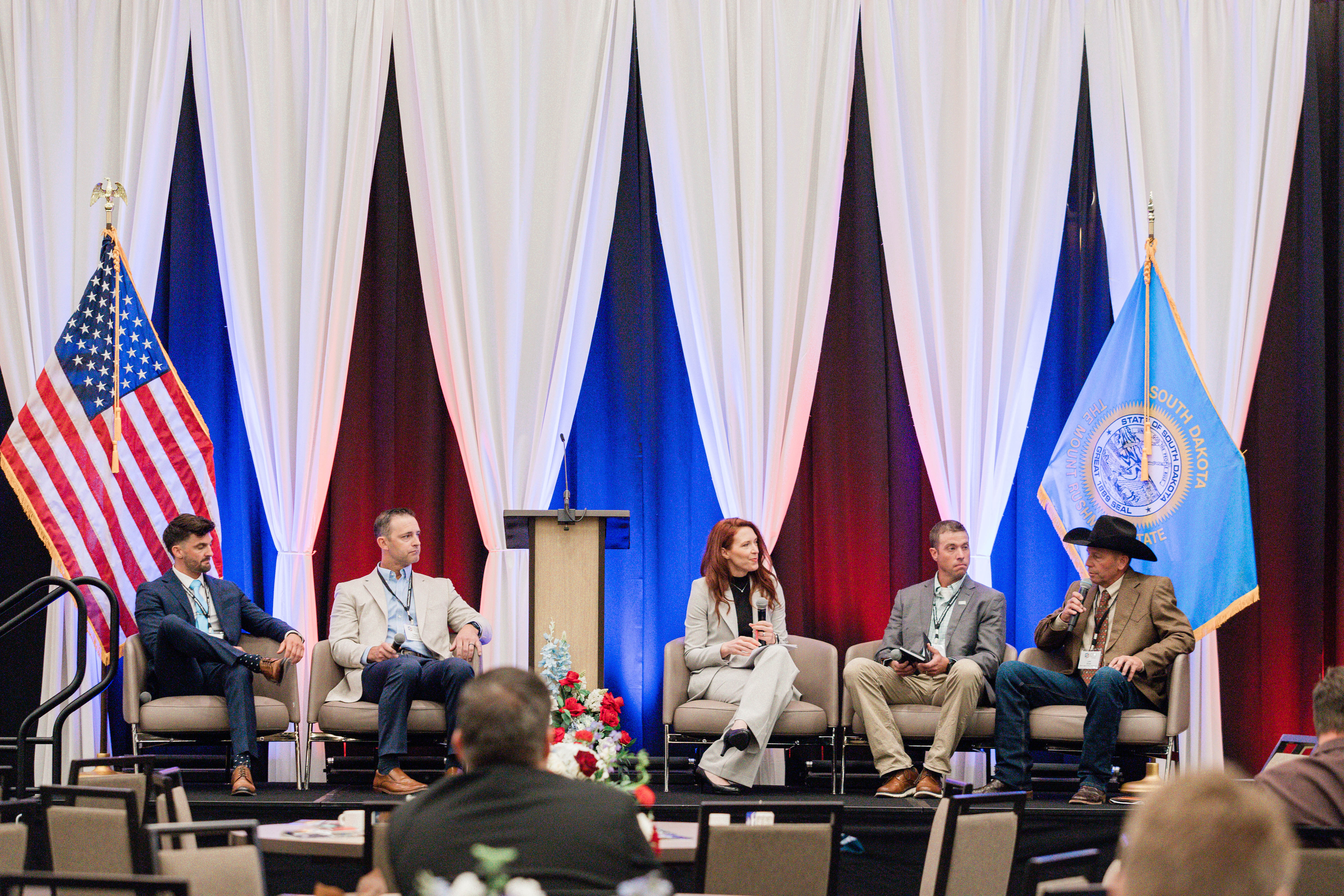
This level of producer investment in key trade relationships is imperative to sustaining strong demand for South Dakota soybeans. "We have to keep showing up and making sure that, while we expand other markets, that we don't neglect the ones that we currently have. The worst thing to do is go into coast mode," said Hento.
He went on to affirm the role farmers play in extending a narrative that accurately reflects the care and commitment of U.S. ag producers. "There's so many bad narratives getting painted out there about agriculture," he said. "We want to show people that we as producers care, that what we're doing is sustainable, that it's healthy."
He also spoke about the importance of value-added agriculture and South Dakota Soybean's role in supporting it. "When we're shipping out whole soybeans, we're losing a lot of dollars that could potentially be generated here within our own state," said Hento. "The soybeans themselves are worth a substantial amount of money. But…when we can develop all these niche markets, that's where we're going to have the opportunities."
Optimism Felt Throughout the Room at Event's Conclusion
In spite of the many acknowledged challenges, a spirit of optimism nevertheless prevailed at the Midwest Agricultural Export Summit. Much of that hopefulness rests on the resilience and resourcefulness of the producers who raise our crops and livestock.
"Nobody can help market products internationally like a U.S. farmer," said Sutter during his panel discussion. "There's a lot of strength here. There's a lot of know-how here. And so I think we just have to continue to be…this reliable, quality, sustainable supplier. [T]hat's the best way we deal with these challenges."